
Discover the vibrant underwater world of the Arabian Sea with Sea Water Sports, the leading authority for safe and certified diving experiences. Whether you are looking for scuba diving in Goa for beginners or you are an experienced diver, our guided trips offer unparalleled safety, state-of-the-art sterilized equipment, and unforgettable marine encounters.
Goa is home to the most accessible scuba diving experience in India. With warm Arabian Sea waters, rich marine life, and certified operators available at every price point, scuba diving in Goa has become the number one bucket-list activity for both domestic and international visitors. Whether you are a complete first-timer with zero swimming ability or an experienced diver looking for a guided professional dive, Goa's underwater world delivers an experience you will not forget.
Sea Water Sports has been operating certified scuba diving experiences at Grand Island, Goa since 2015. Every dive we conduct follows a strict 1-to-1 instructor-to-diver ratio meaning one dedicated PADI or SSI certified professional is assigned exclusively to you from the moment you enter the water until you return to the surface. This is not standard practice across all Goa operators. It is our non-negotiable safety standard and the single biggest reason our customers rate us 4.8 out of 5 across 14,540 verified reviews.
This page covers everything you need to know about scuba diving in Goa prices, dive locations, what to expect as a beginner, whether non-swimmers can participate, the best season, and what is included in each package. Scroll down to book directly or read the complete guide below.
Goa Scuba Diving Overview & Pricing
Feature | Detail |
Price | Rs.1450 (Basic) to Rs.4250 (Pro Dive) |
Dive Location | Grand Island, North Goa |
Dive Duration | 15-20 mins (Basic) / 45 mins (Pro) |
Depth | 5 to 10 meters |
Water Temperature | 27°C to 30°C |
Visibility | Up to 15 metres (Oct-May) |
Swimming Required | No |
Minimum Age | 10 Years |
Certification | PADI & SSI Certified Instructors |
Instructor Ratio | Strict 1:1 |
Best Season | October to May |
Includes | Gear, Boat, Briefing, Lunch, Photos |
Uncompromising Safety Standards
Because Scuba in Goa is an adventure sport, your safety is our non-negotiable priority. Sea Water Sports strictly adheres to international diving protocols:
- 100% Certified Professionals: We do not employ uncertified freelancers. Every underwater guide is a verified PADI or SSI professional.
- 1-to-1 Guided Dives: If you are wondering is scuba diving safe for non swimmers in Goa? The answer is yes. A dedicated instructor manages your buoyancy, holds your tank, and guides your entire dive.
- Medical-Grade Gear Hygiene: All breathing regulators and masks undergo a mandatory 3-step sterilization process
- Antiseptic Wash
- Fresh Water Rinse
- UV Drying after every single use.
- Emergency Preparedness: Every Sea Water Sports dive boat is fully equipped with emergency Oxygen (O2) kits and comprehensive First-Aid supplies.
- Logistics & Transport: Most of our scuba diving packages in Goa include convenient AC or Non-AC pickup and drop-off services, making it incredibly easy if you are staying and looking for scuba diving in North Goa (Calangute, Baga, Candolim, etc.).
Where Do You Dive? Scuba Diving Locations in Goa
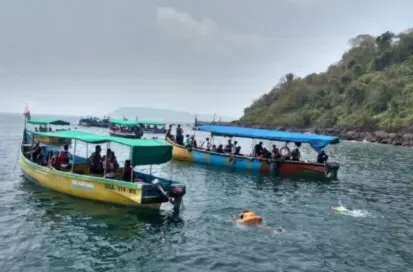
Scuba diving in Goa does not happen directly off the beach. The water near the shore is too shallow and has limited visibility due to tidal activity and boat traffic. All reputable operators, including Sea Water Sports, take divers by boat to offshore dive sites where the water is clear, calm, and rich in marine life.
The boat ride from the jetty takes approximately 40 to 50 minutes and is itself part of the experience, with dolphin sightings frequent along the route.
Grand Island - The Best Dive Site in Goa
Grand Island, locally known as Grande Island, is located approximately 10 kilometres off the coast of Mormugao in North Goa. It is the premier diving destination in Goa and the site where Sea Water Sports conducts all its certified dives. The island is surrounded by a mix of natural rock formations, coral patches, and historically significant shipwrecks that create a diverse and visually spectacular underwater environment.The boat ride from the jetty takes approximately 40 to 50 minutes and is itself part of the experience, with dolphin sightings frequent along the route.
Book the Grand Island Full-Day Scuba Package
Suzy's Wreck - Most Popular Dive Site
Suzy's Wreck is a partially submerged fishing vessel that has become one of Goa's most iconic dive sites. Sitting at around 8 to 10 metres depth, the wreck is now encrusted with corals and inhabited by a wide variety of reef fish. It is suitable for both beginner Discovery Dives and more experienced guided dives. Visibility at this site averages 8 to 12 metres during peak season.Shelter Cove - Best for Beginners
Shelter Cove is the most beginner-friendly dive site at Grand Island. The water here is naturally calmer than the open ocean side of the island due to the protective shape of the cove. Depths range from 5 to 8 metres, making it ideal for first-time divers. Marine life includes Sergeant Major fish, Parrotfish, Snappers, and occasional Sea Turtle sightings during October and November.Bat Island - For Experienced Divers
Bat Island is a more advanced dive site located slightly north of Grand Island, accessible on the Pro Dive package. Depths here reach 15 to 18 metres and the marine biodiversity is significantly richer, including Blue-Spotted Stingrays, large Moray Eels, and diverse coral formations. Not available on the Basic Discovery Dive.What Marine Life Can You See Scuba Diving in Goa?
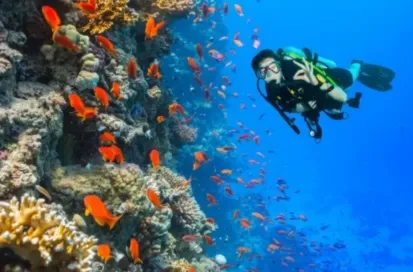
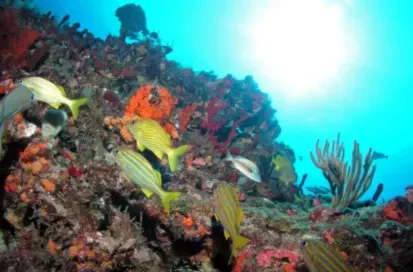
The Arabian Sea off Goa's coast is home to a surprisingly rich ecosystem for a tropical coastal destination. Here is what you are likely to encounter depending on season and dive site:- Reef fish: Bannerfish, Moorish Idols, Angelfish, Parrotfish, Sergeant Major fish, Snappers, and Goatfish. These are visible on virtually every dive throughout the season.
- Bottom dwellers: Blue-Spotted Stingrays, Sea Cucumbers, Starfish, and various crustacean species are commonly seen along the sandy floor near Shelter Cove.
- Occasional sightings: Sea Turtles are most frequently spotted in October and November when they feed near the coral patches at Grand Island. Whale Sharks have been reported in the deeper waters north of Grand Island during early season but are not guaranteed on any dive.
- Coral: Hard coral formations, including Brain Coral and Plate Coral are present at both Suzy's Wreck and Shelter Cove. These formations are protected under Goa's marine conservation guidelines touching or disturbing corals during dives is strictly prohibited.
Scuba Diving in Goa for Beginners - What Happens? Step by Step
The most common question we receive from first-time divers is simple: I have never dived before what actually happens? Here is the complete step-by-step breakdown of what your experience looks like from the moment you arrive at the jetty to the moment you come back up.
Step 1 - Pre-Dive Briefing on the Boat (20 minutes)
Before any diving equipment is put on, your dedicated PADI or SSI certified instructor conducts a thorough safety briefing. This covers three essential things: how to breathe correctly through the regulator mouthpiece, the hand signal system used for underwater communication, and the buddy check procedure. There is no written test and no prior knowledge required. The briefing is designed specifically for complete beginners.Step 2 - Gear Up at the Dive Site
Once the boat anchors at the dive site, your instructor helps you into your equipment. This includes a Buoyancy Control Device (BCD), regulator, mask, fins, and weight belt. All equipment is provided by Sea Water Sports and undergoes a mandatory 3-step sterilisation process after every single use antiseptic wash, fresh water rinse, and UV drying. You are never given equipment that has not been fully cleaned since its last use.Step 3 - Entry Into the Water
Entry is done from the side of the boat using a controlled backward roll entry. Your instructor enters first and positions themselves in the water to receive you. For nervous or first-time divers, a surface swim to acclimatise before descending is always offered.Step 4 - The Descent
Your instructor controls the pace of descent by releasing air from your BCD. Descent happens slowly typically over 2 to 3 minutes to allow your ears to equalise to the increasing water pressure. Your instructor will demonstrate and guide you through the equalisation technique (similar to pinching your nose and gently exhaling). There is no rush. If you are uncomfortable at any depth, the instructor brings you back to a shallower level immediately.Step 5 - The Dive (15 to 20 Minutes)
At depth, your instructor stays physically beside you, maintaining direct contact. You move through the dive site at a relaxed pace, observing the marine life and underwater landscape around you. Your instructor's photographer or video team films your experience from a short distance. This is the 15 to 20 minute period that every first-time diver describes as the most unexpectedly peaceful experience of their life. The silence, the weightlessness, and the colour of the underwater world at Grand Island are genuinely unlike anything above the surface.Step 6 - Ascent and Surface
Ascent is slow and controlled your instructor manages the speed to allow for safe decompression. A safety stop at 5 metres for 3 minutes is observed on all dives. You surface near the boat and your crew assists you back aboard.What If I Feel Panicked Underwater?
This is a real concern for many first-timers and the answer is straightforward. If you feel anxious or want to surface at any point, you communicate this to your instructor using the agreed hand signal (thumb pointing upward). Your instructor will immediately begin a controlled ascent with you. Just to let you know, there is no judgment and no additional charge. Your comfort and safety are non-negotiable this is explicitly trained into every instructor on our team.Scuba Diving in Goa Price Complete Guide
Understanding exactly what you are paying for is important before booking any water sports activity in Goa. Here is a complete, honest breakdown of scuba diving prices in Goa, including what each package at Sea Water Sports includes versus typical walk-in rates.
Sea Water Sports - Package Pricing
| Package | Online Price | Dive Duration | What is Included |
| Basic Discovery Dive | Rs.1450 | 15 to 20 mins | Pickup/drop, boat, gear, briefing, dive, photos, breakfast, lunch |
| Pro Dive | Rs.4250 | 45 mins | Everything in Basic plus advanced equipment and deeper dive site |
Industry Average in Goa
| Package Price | Average Market Price |
| Basic Discovery Dive (No food, no transfer) | Rs.1,500 - Rs.2,000 |
| Basic Discovery Dive (with food & transfer) | Rs.2,500 - Rs.3,500 |
| Pro Guided Dive(with full inclusion) | Rs.5,500 - Rs.9,000 |
The key difference with Sea Water Sports pricing is what is included. Many operators advertising a Rs.1,500 scuba dive do not include pickup, food, or underwater photos; these are charged separately and the total often reaches the same price point. Our package is all-inclusive with no hidden additions at the venue. Explore all water sports activities in Goa
Children's Pricing
Children aged 10 to 17 years receive a flat 20 percent discount on all packages when booked online. Group bookings of 8 or more participants receive additional discounts contact us directly for group rates before booking online.
Is Scuba Diving Safe in Goa? Everything You Need to Know
Scuba diving in Goa is safe when conducted by a certified, registered operator. The question is not whether scuba diving itself is safe internationally, it has an exceptional safety record when conducted properly. The question is which operator you choose to dive with. Here is exactly what separates a genuinely safe operator from an unsafe one.
The 1-to-1 Instructor Ratio: Why It Matters?
Many operators in Goa allow a single instructor to manage 2 or even 3 divers simultaneously. Sea Water Sports does not. Our strict 1-to-1 ratio means you have one certified instructor assigned exclusively to you for your entire dive. This is the international standard for beginner Discovery Dives and the single most important safety measure in recreational diving. If you are evaluating operators, ask them directly about their instructor-to-diver ratio before booking.PADI and SSI Certification What It Means?
PADI (Professional Association of Diving Instructors) and SSI (Scuba Schools International) are the two globally recognised certification bodies for recreational diving. An instructor holding a valid PADI or SSI certification has completed a minimum of 100 logged training dives, a certified rescue diver qualification, and a theoretical examination. At Sea Water Sports, every underwater guide holds one of these certifications. Ask to see the certification card if you want to verify it before your dive.Medical-Grade Equipment Sterilisation
All breathing regulators, masks, and BCDs used at Sea Water Sports undergo a mandatory 3-step sterilisation process after every single use: antiseptic wash, fresh water rinse, and UV drying. This process is not optional or periodic it happens after every individual diver use. This is particularly important given that regulators come into direct contact with your mouth and respiratory system.Emergency Equipment on Every Dive Boat
Every Sea Water Sports dive boat carries emergency oxygen kits and comprehensive first aid supplies. All boat crew members are trained in basic dive emergency response. In the event of any dive-related medical issue, our protocols follow the DAN (Divers Alert Network) emergency response guidelines.Can Non-Swimmers Do Scuba Diving in Goa?
Yes, and this is one of the most misunderstood aspects of beginner scuba diving. Scuba diving does not require swimming ability. The skills required for a Discovery Dive are breathing through a regulator, equalising your ears during descent, and following your instructor's guidance. Your instructor controls your buoyancy, your position in the water, and your pace of movement at all times. Non-swimmers consistently rate their scuba diving experience among the most memorable activities of their Goa trip precisely because the underwater world is so completely different from anything they have experienced at the surface.Who Should Not Dive?
Scuba diving is not suitable for everyone. Please do not book if you are currently pregnant, have been diagnosed with severe asthma or chronic obstructive pulmonary disease, have experienced a heart attack or active cardiac condition within the past 12 months, have had recent ear surgery or active ear infection, or are planning to fly within 24 hours of your dive. If you have any existing medical condition you are unsure about, consult your doctor before booking.Best Time for Scuba Diving in Goa - Month by Month Guide
| Month | Season | Sea Conditions | Visibility | Recommended? |
| October | Early Season | Clam, Settling | 8 - 10 meter | Yes |
| November | Early Peak | Very Calm | 10 - 12 meter | Yes - Turtle Season |
| December | Peak Season | Excellent | 12 - 15 meter | Best Month |
| January | Peak Season | Excellent | 12 - 15 meter | Best Month |
| February | Peak Season | Very good | 10 - 12 meter | Yes |
| March | Late Season | Good | 8 - 10 meter | Yes |
| April | End of Season | Warming | 6 - 8 meter | Yes |
| May | End of Season | Acceptable | 5 - 8 meter | Yes |
| June | Monsoon | Poor | Poor | Closed |
| July | Monsoon | Very Rough | Very Poor | Closed |
| August | Monsoon | Very Rough | Very Poor | Closed |
| September | Monsoon | Rough | Poor | Closed |
December and January consistently offer the best combination of underwater visibility, sea surface conditions, and water temperature for scuba diving in Goa. If your travel dates are flexible, plan your dive for the morning of a December or January day for the best possible experience.
The monsoon closure from June to September is enforced by the Goa Maritime Board, not just by individual operators. All dive boats in Goa are legally prohibited from operating during this period due to safety regulations.
The monsoon closure from June to September is enforced by the Goa Maritime Board, not just by individual operators. All dive boats in Goa are legally prohibited from operating during this period due to safety regulations.
How to Reach the Scuba Diving Pickup Point in Goa?
Sea Water Sports arranges shared pickup from designated main road collection points in Calangute, Baga, Candolim, and Arpora. Pickup begins at 7:30 AM. Your exact pickup point and timing will be confirmed by our team via WhatsApp or SMS after your booking is completed.
If you are travelling independently to the jetty, the departure point is Mormugao Jetty near Vasco da Gama, approximately 45 to 50 minutes by road from Calangute Beach. Private taxi booking through your hotel is the most convenient independent travel option. Parking is available at the jetty for guests travelling by their own vehicle or rented scooter.
Why Over 14,540 Divers Chose Sea Water Sports for Scuba Diving in Goa?
Choosing the right operator for scuba diving in Goa is as important as choosing the destination itself. Here is what makes Sea Water Sports the most reviewed scuba diving operator in North Goa:
- Strict 1-to-1 instructor ratio on every dive - no shared instructors, no compromises on personal safety.
- 100 percent certified professionals - every underwater guide holds a valid PADI or SSI certification. We do not employ uncertified freelancers, which is unfortunately common at some beach-side operators.
- Medical-grade equipment sterilisation after every single use - antiseptic wash, fresh water rinse, and UV drying on all regulators and masks.
- Emergency oxygen kits on every dive boat - DAN-standard emergency response protocols followed by all boat crew.
- All-inclusive pricing - pickup from North Goa, boat ride, dolphin spotting, breakfast, dive gear, certified instructor, 15-20 minute guided dive, underwater photos and videos, and buffet beach lunch. No hidden charges added at the venue.
- Flexible cancellation - cancellations made at least 48 hours in advance receive a full refund. Weather-related cancellations are rescheduled at no additional cost.
- 14,540 verified reviews with a 4.8 out of 5 rating - the largest verified review base of any single scuba operator listed on our platform.